A Framework by Justin McKelvey · June 2026

The Business Brain

The context layer that makes AI sound like your business — not generic.

Quick Answer

The Business Brain is a structured AI context layer — brand voice, offers, ICP, and sales motion — captured once and used by every AI workflow forever. It's the missing layer Anthropic, OpenAI, and other LLM vendors deliberately leave out, because a generic Brain would be worse than none. When Anthropic shipped Claude for Small Business on May 13, 2026, they delivered the engine (8 connectors + 15 workflows + 15 skills) but not the brain. The Business Brain is built per business and lives inside Claude as a permanent project context, so every workflow inherits it without re-prompting.

Coined by Justin McKelvey, fractional CTO · 15+ years shipping products · Updated June 2026

What is the Business Brain?

Every AI workflow that touches your business — drafting a proposal, replying to a support ticket, writing a social post, summarizing a discovery call — needs the same four pieces of context to sound like you instead of like a generic AI assistant. Without those four pieces, you re-paste your brand voice, re-explain your offers, re-describe your ICP every single time you prompt the AI.

The Business Brain is what happens when you stop re-pasting. You capture the 4 layers once, in a structured format the AI can consume, and they live in Claude (or ChatGPT) as a permanent context layer. Every workflow you build on top inherits all four automatically.

It's not a brand guidelines doc. A brand guidelines doc is for humans — long, prose-heavy, written to be read once and referenced. A Business Brain is for AI — structured, exemplar-driven, written to be consumed and applied. The brand voice section doesn't say "we sound confident yet approachable." It includes a real 500-word writing sample the AI can match.

The Structure

What are the 4 layers of the Business Brain?

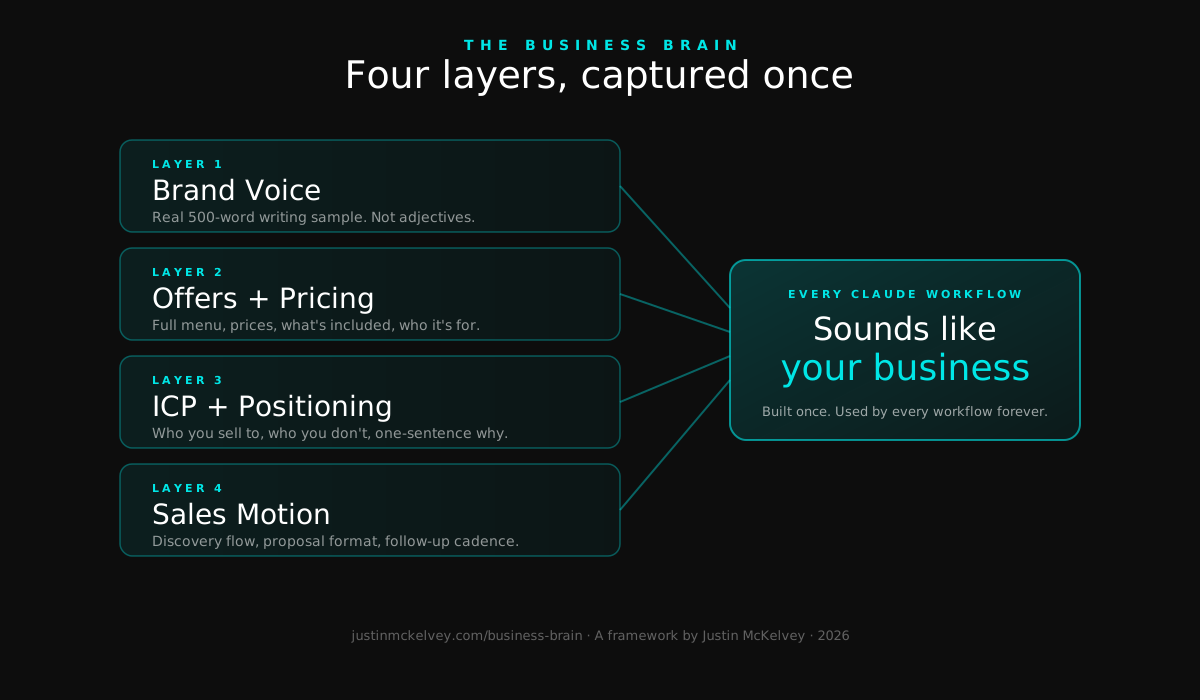
Diagram of the four-layer Business Brain methodology — Brand Voice, Offers and Pricing, ICP and Positioning, and Sales Motion — feeding into every Claude workflow so output sounds like your business instead of generic AI.
The four layers · captured once · inherited by every workflow

Layer 1

Brand Voice

What it is: How your business writes and speaks — captured with a real 500-word writing sample, not adjectives.

Why a sample, not adjectives: "Confident yet approachable" is meaningless to an LLM. A 500-word real example of your writing — a sales email you sent, a LinkedIn post you wrote, a customer reply you sent — gives the AI specific syntax, rhythm, vocabulary, and tone to match. The AI matches patterns. Give it patterns to match.

How to capture it: Pick the single piece of writing in your archive that most sounds like you on a good day. Paste it. Add 2–3 short notes about what to do (use contractions, short paragraphs, named examples) and what to avoid (corporate jargon, "leverage," "synergy"). That's it.

Layer 2

Offers + Pricing

What it is: The full menu of what you sell, what it costs, and how each tier is differentiated.

Why it matters: Without this, the AI can't quote you to a lead, can't draft a proposal that names the right tier, can't qualify whether a prospect is a fit. Every reply that touches money requires re-pasting context. With it, the AI can write a proposal in your voice that names the right offer, at the right price, with the right scope.

How to capture it: List your 2–5 standard offers. For each: name, price (or price range), what's included, what's NOT included, the buyer persona, typical timeline. Add à la carte add-ons with prices. Update it when pricing changes — the Brain is a living doc.

Layer 3

ICP + Positioning

What it is: Who you sell to, who you don't, and the one-sentence reason you're worth choosing.

Why it matters: Lead qualification, proposal scoping, ad-copy drafts, content output — all of these are dramatically better when the AI knows the audience. "Write a LinkedIn post about AI" produces sludge. "Write a LinkedIn post about AI for $1M–$50M operators who are skeptical of vendor pitches" produces something you'd actually post.

How to capture it: One paragraph each on (1) ICP — revenue band, industry, role of the buyer, what they're trying to solve; (2) anti-ICP — who you turn down and why; (3) positioning — the one sentence that distinguishes you from the most obvious alternative.

Layer 4

Sales Motion

What it is: How you actually win business — the discovery flow, proposal format, follow-up cadence, and objection handling that's worked.

Why it matters: This is the layer that lets the AI do useful sales-adjacent work — drafting follow-up emails after discovery calls, generating proposals from notes, writing objection responses, summarizing call recordings into next steps. Without this layer, the AI guesses at your sales motion and outputs generic SaaS-blog cadence emails.

How to capture it: Document your actual discovery call structure (the questions you ask, in the order you ask them). One example proposal in your standard format. Your standard follow-up sequence (Day 1, Day 3, Day 7 — with the angles you use). Two or three objection responses that have worked. That's enough for the AI to model the motion.

Why doesn't Claude or ChatGPT come with a Business Brain built in?

Because every business needs a different one. A brand voice for a B2B SaaS sounds nothing like a brand voice for a DTC skincare brand. A sales motion for a $50K enterprise deal looks nothing like a sales motion for a $97 digital product. An ICP for a fractional CTO is the opposite of an ICP for a 7-figure HVAC operator.

Anthropic shipped Claude for Small Business on May 13, 2026, with 8 native connectors (QuickBooks, HubSpot, Slack, Google Workspace, Microsoft 365, Canva, DocuSign, PayPal), 15 ready-to-run workflows, and 15 reusable skills. They built the engine. They deliberately left the brain out.

That decision is correct. A generic Brain would be worse than no Brain — it would push every business toward the same flattened voice, the same template proposals, the same average outputs. The brain has to be captured per business. That capture is what I do for clients, and it's what the Business Brain framework formalizes so other operators can do it themselves.

Where does the Business Brain live?

Inside Claude (or your AI of choice) as a permanent project context. Specifically:

  • Claude: as a Claude Project with the Brain pinned as the system instructions, OR as a CLAUDE.md file at the root of your Claude Cowork workspace.
  • ChatGPT Team: as Custom Instructions at the org level, plus a pinned Project containing the full Brain doc as a reference file.
  • Microsoft Copilot: as an organizational context that ships with every prompt.

Every workflow you build on top of the Brain inherits it automatically. You don't re-paste your brand voice every time you ask Claude to draft a follow-up email. The voice is already there. The offers are already there. The ICP is already there. The motion is already there. You just say "draft a follow-up to the call I just had with Sarah" — and the output is in your voice, naming the right offer, qualifying Sarah against your ICP, following your standard cadence.

Questions

Frequently asked

What is the Business Brain?
The Business Brain is a structured context layer for AI assistants (Claude, GPT, and others) that captures the 4 things every business workflow needs but no AI ships with: your brand voice (with a real writing sample), your offers and pricing, your ICP and positioning, and your sales motion. Built once, used by every workflow forever. Coined by Justin McKelvey, fractional CTO, 2026.
What are the 4 layers of the Business Brain?
Brand Voice (how you write and speak — captured with a real writing sample, not adjectives), Offers + Pricing (what you sell and what it costs), ICP + Positioning (who you serve, who you don't, and why), and Sales Motion (how you actually win — discovery flow, proposal format, follow-up cadence). All 4 are required. Missing any one and AI output regresses to generic.
Why doesn't Claude or ChatGPT come with a Business Brain built in?
Because every business needs a different one — a brand voice for a B2B SaaS sounds nothing like a brand voice for a DTC skincare brand. Anthropic shipped Claude for Small Business in May 2026 with 8 connectors and 15 workflows, but deliberately left the context layer out. A generic Brain would be worse than none. The Brain has to be captured per business.
Where does the Business Brain live?
Inside Claude (or your AI of choice) as a permanent project context — typically a Claude project, a CLAUDE.md file at the root of your Claude Cowork workspace, or the equivalent system-prompt layer in ChatGPT Team. Every workflow you build on top of the Brain inherits it automatically. You don't re-paste your brand voice every time you ask Claude to draft something.
How is the Business Brain different from a brand guidelines doc?
A brand guidelines doc is for humans — long, prose-heavy, written to be read. A Business Brain is for AI — structured, exemplar-driven, written to be consumed and applied. The brand voice section, for example, doesn't say 'we sound confident yet approachable.' It includes a real 500-word writing sample the AI can match. Brand docs describe. Brains demonstrate.
Can I build a Business Brain without hiring someone?
Yes. The Claude for Small Business Playbook ($497, early-bird $397 for waitlist signups) is the DIY version — it walks you through the 4-layer capture with fill-in-the-blank templates and example outputs from real businesses. Expect ~6 focused hours to build it yourself. If you'd rather have it built for you, the done-for-you install starts at $4,500 and includes the full Brain capture in your voice.
Does the Business Brain work with ChatGPT, not just Claude?
Yes — the structure is portable across LLMs. Built originally for Claude (Anthropic's structured-context model handles the 4 layers cleanly), the same Business Brain document works inside ChatGPT Team as a custom instruction, in Microsoft Copilot as an organizational context, or in any LLM with a persistent system-prompt layer. The methodology is model-agnostic; the implementation defaults to Claude because Claude for Small Business ships the operational scaffolding.
How long until a Business Brain pays for itself?
For most $1M–$5M businesses, the Brain pays back in ~6 weeks of recovered time once it's powering 3–5 weekly workflows (proposals, follow-up emails, customer-service drafts, content drafts, weekly reports). The math: a 6-hour-per-week time saving at $150/hour-equivalent labor cost is ~$900/week — recovers a $4,500 install in about 5 weeks. The Playbook recovers in days.
Ready to build your Brain?

Two paths. Same destination — a working Brain pinned inside Claude, with the workflows that consume it.